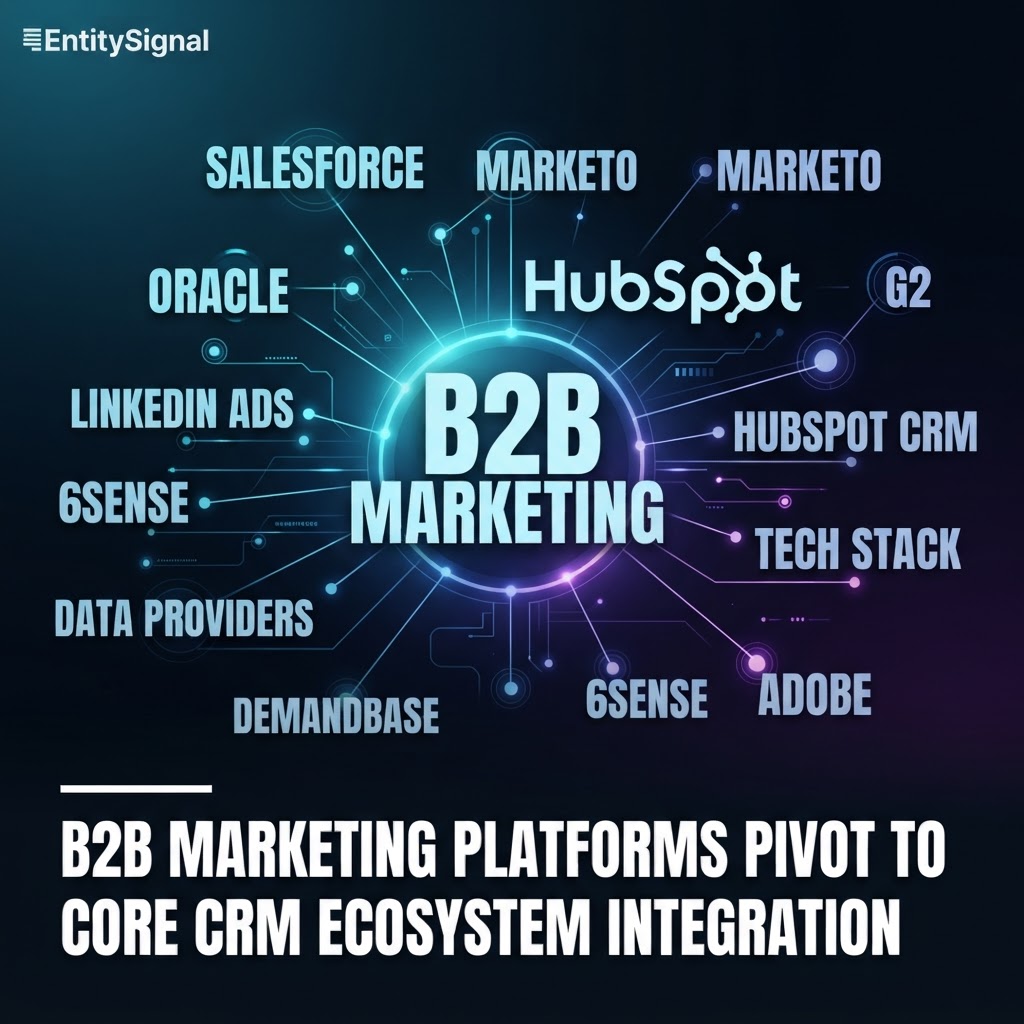
B2B Marketing Platforms Pivot to Core CRM Ecosystem Integration
Emerging data reveals B2B Marketing's strategic alignment with HubSpot and Salesforce, signaling a move toward deeper platform interoperability. This intelligence highlights a critical shift in how marketing solutions are architecting their value propositions within established enterprise ecosystems.
The B2B Marketing landscape is undergoing a significant architectural consolidation, underscored by the newly mapped integrations with industry titans HubSpot and Salesforce Marketing Cloud. By positioning itself as a core ecosystem member within HubSpot and establishing functional interoperability with Salesforce, B2B Marketing is effectively insulating its market share by embedding its feature set directly into the workflows of the modern enterprise. This strategy marks a departure from standalone 'point solutions' toward becoming a critical data-layer contributor within the customer lifecycle. For HubSpot users, the designation as an ecosystem member implies a deeper, likely native, integration that leverages HubSpot’s CRM data to drive automated marketing campaigns. Simultaneously, the integration with Salesforce Marketing Cloud suggests a commitment to addressing the complex, multi-layered requirements of large-scale, high-velocity sales teams. From an intelligence perspective, this dual-path strategy is a deliberate play to capture both mid-market velocity and enterprise-grade stability. By integrating with these dominant players, the entity is significantly reducing the friction associated with platform migration and data silos, effectively transforming its platform from a peripheral tool into a mission-critical component of the enterprise technology stack. ### What This Means The implications for competitive positioning are profound. First, B2B Marketing is actively neutralizing the 'switching cost' barrier by ensuring that their solution thrives within the environments where customer data already resides. Second, this move signals a broader trend where marketing software is shifting away from being a destination and toward becoming an invisible, high-utility layer that powers CRM platforms. Competitors in the B2B space who fail to secure deep-tissue integrations with these incumbents risk being relegated to 'shadow IT' or discarded as redundant in favor of more cohesive, unified suites. Moving forward, stakeholders should monitor how these integrations influence the entity’s churn rates and expansion metrics, as successful ecosystem alignment often serves as a primary leading indicator for long-term customer retention and sustained valuation growth.
Cross-Linked Intelligence
Related Discoveries — Semantic Match
This Article Connects To™
Connected Entities
Related Topics
This intelligence story connects 2 primary entities, 10 eligible public relationships, 6 related topics, and 8 neighboring companies across the EntitySignal graph.
🌐 Continue Exploring the Intelligence Network™
You're not reading a blog — you're exploring a living knowledge graph. Every discovery connects to dozens more.
50
Related Discoveries (bounded)
2
Connected Companies (bounded)
20
Ecosystem Articles (bounded)
12
Competitive Insights (bounded)
Related Partnerships
Mailgun Integration with HubSpot Identified by EntitySignal Browser
Mailgun
43d ago
Clearbit Integrates With HubSpot: Mapping the Latest B2B Tech Connectivity
43d ago
Cloudsmith Ecosystem Connectivity: Google Cloud, Microsoft Azure, and GitHub Integrations
49d ago
InfoSum Integrates with HubSpot: Mapping the Data Connectivity Signal
50d ago
Same Ecosystem
Mailgun Integration with HubSpot Identified by EntitySignal Browser
Mailgun
43d ago
Vultr Deepens Integration within the Expanding Kubernetes Ecosystem
Vultr
43d ago
Clearbit Integrates With HubSpot: Mapping the Latest B2B Tech Connectivity
43d ago
Mapping the Foundational Link Between Linux Containers and Docker
48d ago
Similar Companies
Vultr Deepens Integration within the Expanding Kubernetes Ecosystem
Vultr
43d ago
Mapping the Competitive Landscape: Backblaze and AWS
43d ago
Mapping the Foundational Link Between Linux Containers and Docker
48d ago
Mapping the Digital Footprint: Bundesbank and Wikipedia Proximity
48d ago
Trending Intelligence
Cloudsmith Ecosystem Connectivity: Google Cloud, Microsoft Azure, and GitHub Integrations
49d ago
Mapping Klaviyo’s Strategic Ecosystem: Partnerships and Competitive Positioning
Klaviyo
55d ago
Mapping the Connectivity Landscape Surrounding Mailgun
Mailgun
57d ago
Mapping Vultr's Competitive and Collaborative Ecosystem
Vultr
57d ago
🌐 Keep Exploring the EntitySignal Intelligence Network™