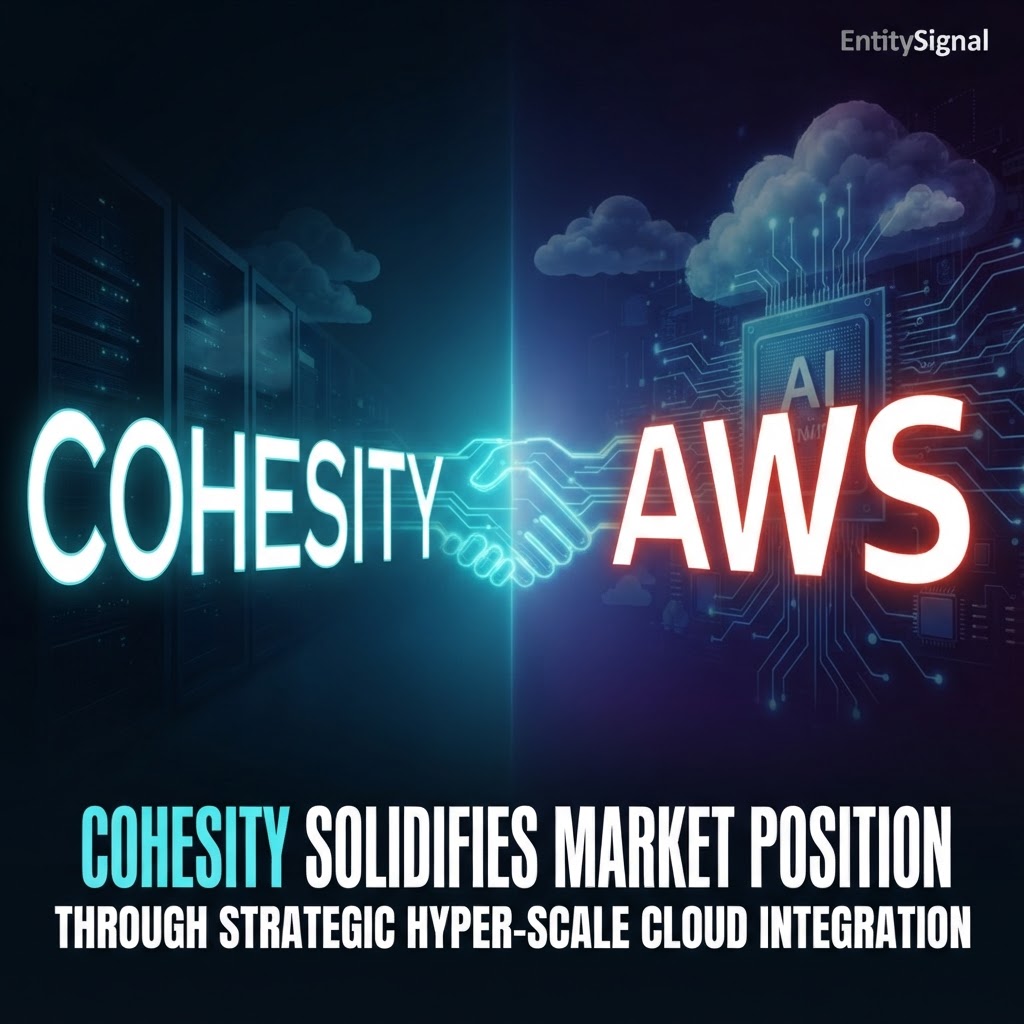
Cohesity Solidifies Market Position Through Strategic Hyper-Scale Cloud Integration
Cohesity has aggressively expanded its ecosystem footprint by formalizing deep-level integrations with AWS, Microsoft Azure, and Google Cloud. This multi-cloud strategy signals a shift from traditional data storage toward becoming the essential management layer for enterprise hybrid infrastructure.
The Multi-Cloud Data Fabric Strategy
Cohesity’s recent surge in deep integrations with the 'Big Three' hyperscalers—Amazon Web Services (AWS), Microsoft Azure, and Google Cloud—marks a calculated evolution in the company’s enterprise positioning. By securing high-confidence interoperability with these platforms, Cohesity is successfully transitioning from a localized backup and recovery vendor into a critical orchestrator of the modern multi-cloud data fabric.
Historically, data management vendors struggled to maintain parity across distinct cloud architectures. Cohesity has bypassed this hurdle by adopting a platform-agnostic approach, allowing enterprise IT departments to manage, secure, and recover data workloads regardless of their physical or virtual location. This move effectively diminishes the risk of vendor lock-in for their enterprise clients, a selling point that carries significant weight in current procurement cycles.
Strategic Implications and Competitive Context
The decision to integrate simultaneously with AWS, Azure, and Google Cloud places Cohesity in a prime position to capture the 'hybrid-cloud paradox.' While enterprises are accelerating their transition to cloud-native environments, they remain anchored to on-premises infrastructure for performance and regulatory reasons. Cohesity serves as the connective tissue between these worlds. By treating public clouds as extensions of the local data center rather than silos, Cohesity forces incumbents—who often rely on disparate point solutions—to defend their fragmentation against Cohesity’s unified management architecture.
Furthermore, this partnership strategy with Google Cloud, alongside native integrations with AWS and Azure, indicates a focus on 'Data Security as a Service.' By positioning its technology as the underlying layer that provides ransomware protection and threat detection across these disparate cloud environments, Cohesity is moving up the value chain from utility software to a core security pillar.
What This Means
- Ecosystem Dominance: Cohesity is successfully insulating itself from the fluctuations of any single cloud provider's success by diversifying its reach.
- Operational Efficiency: Enterprises can now leverage a singular control plane, reducing the operational overhead associated with managing heterogeneous cloud environments.
- Market Differentiation: The company is distancing itself from legacy backup providers by emphasizing data management, governance, and cyber resilience rather than simple storage capacity.
Moving forward, the primary metric for Cohesity’s success will be its ability to maintain these integrations as hyperscalers evolve their internal security and API structures. As the data sovereignty landscape becomes increasingly complex, Cohesity’s role as an independent, cross-platform mediator provides it with substantial leverage within the enterprise software ecosystem.
Cross-Linked Intelligence
Related Discoveries — Semantic Match
This Article Connects To™
Connected Entities
Related Topics
This intelligence story connects 3 primary entities, 94 eligible public relationships, 7 related topics, and 60 neighboring companies across the EntitySignal graph.Counts reflect a bounded eligible public result set.
🌐 Continue Exploring the Intelligence Network™
You're not reading a blog — you're exploring a living knowledge graph. Every discovery connects to dozens more.
50
Related Discoveries (bounded)
3
Connected Companies (bounded)
19
Ecosystem Articles (bounded)
12
Competitive Insights (bounded)
Related Partnerships
Cloudsmith Ecosystem Connectivity: Google Cloud, Microsoft Azure, and GitHub Integrations
49d ago
Mapping InfoSum: Emerging Infrastructure Connectivity and Ecosystem Integrations
58d ago
Mapping the Ecosystem Connectivity of JFrog: A Relational Analysis
58d ago
inContact Deepens Ecosystem Integration with Salesforce and AWS Strategic Alliances
60d ago
Same Ecosystem
Vultr Deepens Integration within the Expanding Kubernetes Ecosystem
Vultr
43d ago
Mapping the Competitive Landscape: Backblaze and AWS
43d ago
Mapping the Foundational Link Between Linux Containers and Docker
48d ago
Mapping the Digital Footprint: Bundesbank and Wikipedia Proximity
48d ago
Similar Companies
Mailgun Integration with HubSpot Identified by EntitySignal Browser
Mailgun
43d ago
Mapping the Competitive Landscape: Backblaze and AWS
43d ago
Clearbit Integrates With HubSpot: Mapping the Latest B2B Tech Connectivity
43d ago
Cloudsmith Ecosystem Connectivity: Google Cloud, Microsoft Azure, and GitHub Integrations
49d ago
Trending Intelligence
Cloudsmith Ecosystem Connectivity: Google Cloud, Microsoft Azure, and GitHub Integrations
49d ago
Mapping Klaviyo’s Strategic Ecosystem: Partnerships and Competitive Positioning
Klaviyo
55d ago
Mapping the Connectivity Landscape Surrounding Mailgun
Mailgun
57d ago
Mapping Vultr's Competitive and Collaborative Ecosystem
Vultr
57d ago
🌐 Keep Exploring the EntitySignal Intelligence Network™