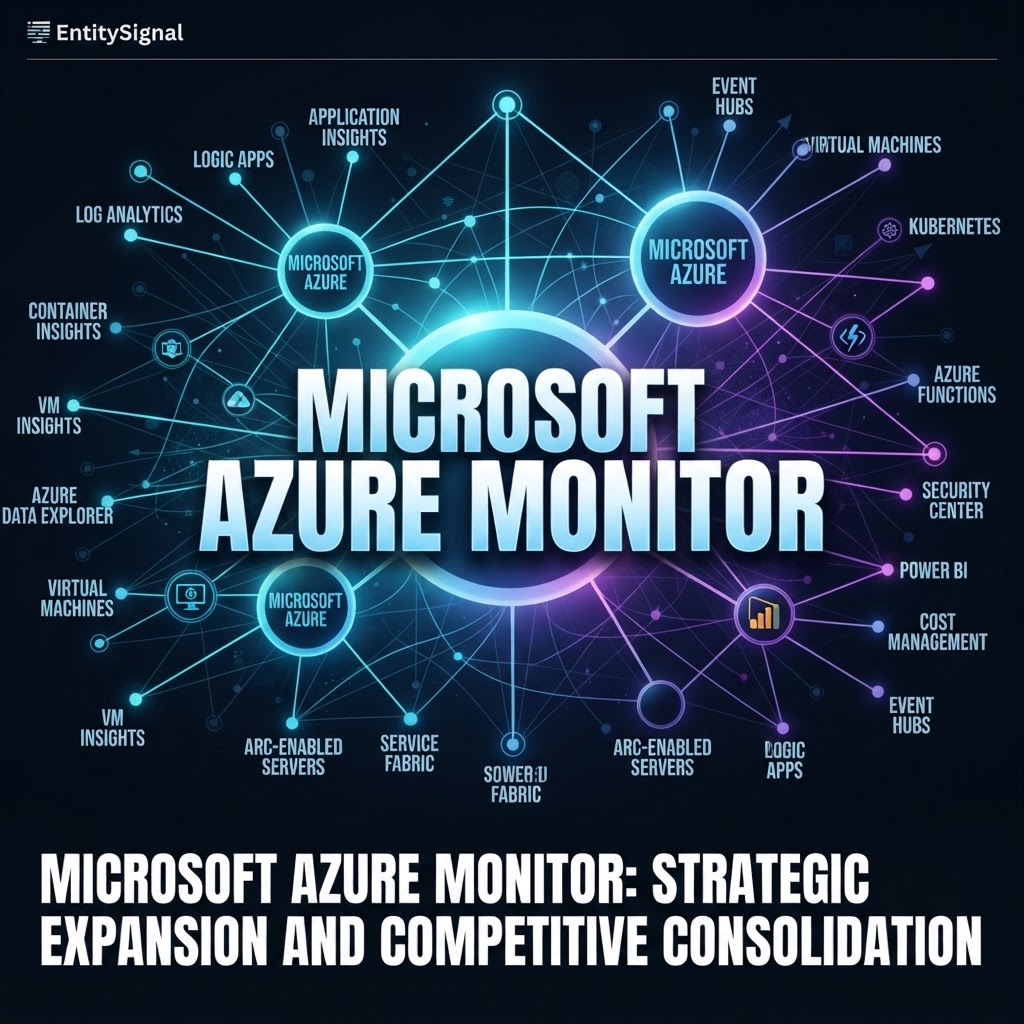
Microsoft Azure Monitor: Strategic Expansion and Competitive Consolidation
Microsoft Azure Monitor is solidifying its position as a central pillar of the Azure ecosystem while directly challenging independent observability leaders. This analysis explores how Microsoft is leveraging native integration to capture market share from third-party monitoring platforms.
The Evolution of Azure Monitor
Microsoft Azure Monitor has evolved from a utility tool into a foundational strategic asset within the broader Microsoft Azure ecosystem. By serving as the primary observability layer for infrastructure and application health, Azure Monitor facilitates a 'sticky' environment that encourages deeper customer reliance on Microsoft cloud infrastructure. As an entity fully owned by Microsoft, its development roadmap is intrinsically linked to the acceleration of Azure's feature velocity.
Competitive Landscape and Market Positioning
The positioning of Azure Monitor serves as a direct competitive counter-offensive against independent observability platforms like Datadog. In the current enterprise landscape, customers are increasingly evaluating the trade-offs between 'best-of-breed' independent tools and integrated ecosystem solutions. By offering a unified monitoring experience that resides natively within the Azure control plane, Microsoft is effectively reducing the total cost of ownership for its users, thereby creating a significant friction point for Datadog's customer acquisition strategies within the Azure footprint.
Furthermore, Azure Monitor acts as a strategic gatekeeper when organizations consider multi-cloud deployments. By providing a high-fidelity monitoring alternative to Google Cloud’s operations suite, Microsoft is positioning its native tooling as a primary deterrent against the migration of workloads to competing cloud providers. This creates a defensive moat, as the complexity of re-instrumenting monitoring workflows acts as a deterrent for potential cloud churn.
What This Means
-
Increased Ecosystem Lock-in: By integrating observability directly into the Azure fabric, Microsoft is raising the switching costs for enterprise clients. This trend reinforces the 'walled garden' approach, making it increasingly difficult for independent monitoring vendors to prove value proposition parity.
-
Strategic Consolidation: The industry is witnessing a trend where native cloud-provider tooling is encroaching upon the territory of specialized monitoring vendors. This suggests that the future of observability will likely be defined by platform-native capabilities that offer seamless automation and lower latency integration.
-
Competitive Pressure on Independents: Platforms like Datadog will likely need to pivot toward advanced AIOps or cross-cloud visibility that transcends single-provider ecosystems to maintain their value proposition. The ongoing tug-of-war between specialized observability vendors and native cloud monitoring tools will remain a primary driver of innovation in the DevOps sector.
Cross-Linked Intelligence
Related Discoveries — Semantic Match
Related Trends
This Article Connects To™
Connected Entities
Related Topics
This intelligence story connects 4 primary entities, 80 eligible public relationships, 9 related topics, and 59 neighboring companies across the EntitySignal graph.Counts reflect a bounded eligible public result set.
🌐 Continue Exploring the Intelligence Network™
You're not reading a blog — you're exploring a living knowledge graph. Every discovery connects to dozens more.
50
Related Discoveries (bounded)
4
Connected Companies (bounded)
10
Ecosystem Articles (bounded)
12
Competitive Insights (bounded)
Related Partnerships
Same Ecosystem
Vultr Deepens Integration within the Expanding Kubernetes Ecosystem
Vultr
43d ago
Mapping the Competitive Landscape: Backblaze and AWS
43d ago
Mapping the Foundational Link Between Linux Containers and Docker
48d ago
Mapping the Digital Footprint: Bundesbank and Wikipedia Proximity
48d ago
Similar Companies
Vultr Deepens Integration within the Expanding Kubernetes Ecosystem
Vultr
43d ago
Mapping the Competitive Landscape: Backblaze and AWS
43d ago
Mapping the Foundational Link Between Linux Containers and Docker
48d ago
Mapping the Digital Footprint: Bundesbank and Wikipedia Proximity
48d ago
Trending Intelligence
Cloudsmith Ecosystem Connectivity: Google Cloud, Microsoft Azure, and GitHub Integrations
49d ago
Mapping Klaviyo’s Strategic Ecosystem: Partnerships and Competitive Positioning
Klaviyo
55d ago
Mapping the Connectivity Landscape Surrounding Mailgun
Mailgun
57d ago
Mapping Vultr's Competitive and Collaborative Ecosystem
Vultr
57d ago
🌐 Keep Exploring the EntitySignal Intelligence Network™