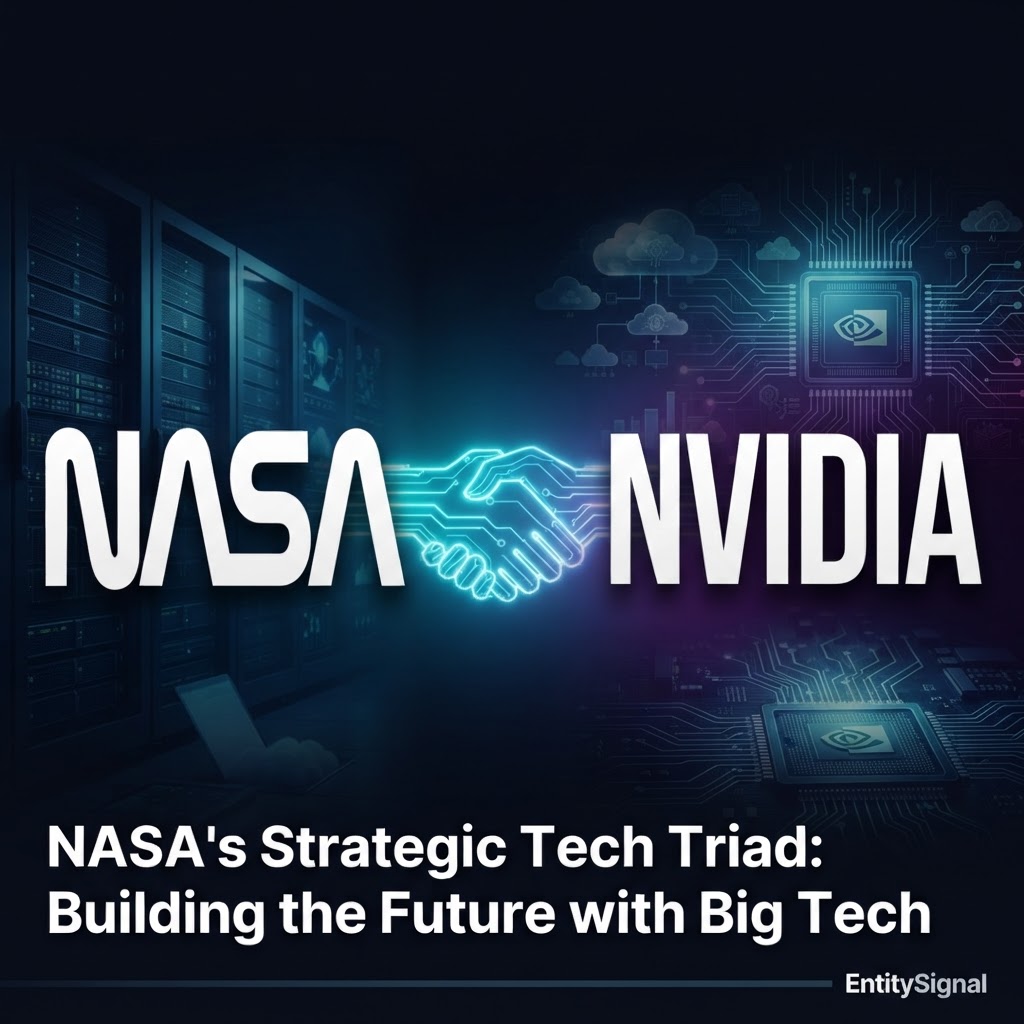
NASA's Strategic Tech Triad: Building the Future with Big Tech
NASA is increasingly formalizing deep-tech partnerships with NVIDIA, Amazon, and Google to accelerate aerospace innovation. This triad signals a move toward integrating scalable cloud infrastructure and advanced computing into the heart of space exploration.
The New Aerospace Ecosystem
NASA’s recent consolidation of partnerships with NVIDIA, Amazon, and Google represents a significant strategic pivot in how the agency approaches space exploration. By offloading resource-intensive computing and data storage to industry leaders, NASA is essentially transitioning from a self-contained research entity to a modern, platform-oriented agency. This shift is not merely about procurement; it is about leveraging the most powerful commercial infrastructure available to solve complex orbital and planetary challenges.
The Triad Dynamics
- NVIDIA: The collaboration with NVIDIA focuses on simulation and high-performance computing (HPC). As NASA pushes further into autonomous robotics and mission-critical AI, NVIDIA’s compute stack provides the necessary backbone for digital twin environments and real-time planetary navigation.
- Amazon & Google: These partnerships center on cloud-scale infrastructure. The vast amounts of telemetry data generated by modern satellite constellations and deep-space probes require the elastic, global scale provided by AWS and Google Cloud. By tapping into these ecosystems, NASA can distribute information faster to research partners, moving away from siloed data processing.
What This Means
For the industry, these relationships create a formidable barrier to entry for smaller aerospace firms that lack the ability to integrate with these "Big Three" tech stacks. NASA is effectively setting a new standard for mission operations: if it cannot be simulated in a digital twin (NVIDIA) or processed in a hyperscale cloud (Amazon/Google), it is unlikely to secure a long-term roadmap at the agency.
Strategically, this creates a 'platform dependency' where the future of American space dominance is physically tethered to the private sector’s server farms. While this maximizes efficiency and innovation speed, it also centralizes critical infrastructure risk. Competitors in the space sector must now view NASA’s hardware requirements through the lens of these cloud-native and GPU-accelerated partnerships, as the agency moves away from bespoke, isolated systems toward integrated, software-defined space infrastructure.
Cross-Linked Intelligence
Related Discoveries — Semantic Match
Related Trends
This Article Connects To™
Connected Entities
Related Topics
Related Companies
This intelligence story connects 4 primary entities, 108 eligible public relationships, 10 related topics, and 60 neighboring companies across the EntitySignal graph.Counts reflect a bounded eligible public result set.
🌐 Continue Exploring the Intelligence Network™
You're not reading a blog — you're exploring a living knowledge graph. Every discovery connects to dozens more.
50
Related Discoveries (bounded)
4
Connected Companies (bounded)
6
Ecosystem Articles (bounded)
12
Competitive Insights (bounded)
Related Partnerships
Mailgun Integration with HubSpot Identified by EntitySignal Browser
Mailgun
43d ago
Clearbit Integrates With HubSpot: Mapping the Latest B2B Tech Connectivity
43d ago
Cloudsmith Ecosystem Connectivity: Google Cloud, Microsoft Azure, and GitHub Integrations
49d ago
InfoSum Integrates with HubSpot: Mapping the Data Connectivity Signal
50d ago
Same Ecosystem
Vultr Deepens Integration within the Expanding Kubernetes Ecosystem
Vultr
43d ago
Mapping the Competitive Landscape: Backblaze and AWS
43d ago
Mapping the Foundational Link Between Linux Containers and Docker
48d ago
Mapping the Digital Footprint: Bundesbank and Wikipedia Proximity
48d ago
Similar Companies
Mailgun Integration with HubSpot Identified by EntitySignal Browser
Mailgun
43d ago
Mapping the Competitive Landscape: Backblaze and AWS
43d ago
Clearbit Integrates With HubSpot: Mapping the Latest B2B Tech Connectivity
43d ago
Cloudsmith Ecosystem Connectivity: Google Cloud, Microsoft Azure, and GitHub Integrations
49d ago
Trending Intelligence
Cloudsmith Ecosystem Connectivity: Google Cloud, Microsoft Azure, and GitHub Integrations
49d ago
Mapping Klaviyo’s Strategic Ecosystem: Partnerships and Competitive Positioning
Klaviyo
55d ago
Mapping the Connectivity Landscape Surrounding Mailgun
Mailgun
57d ago
Mapping Vultr's Competitive and Collaborative Ecosystem
Vultr
57d ago
🌐 Keep Exploring the EntitySignal Intelligence Network™