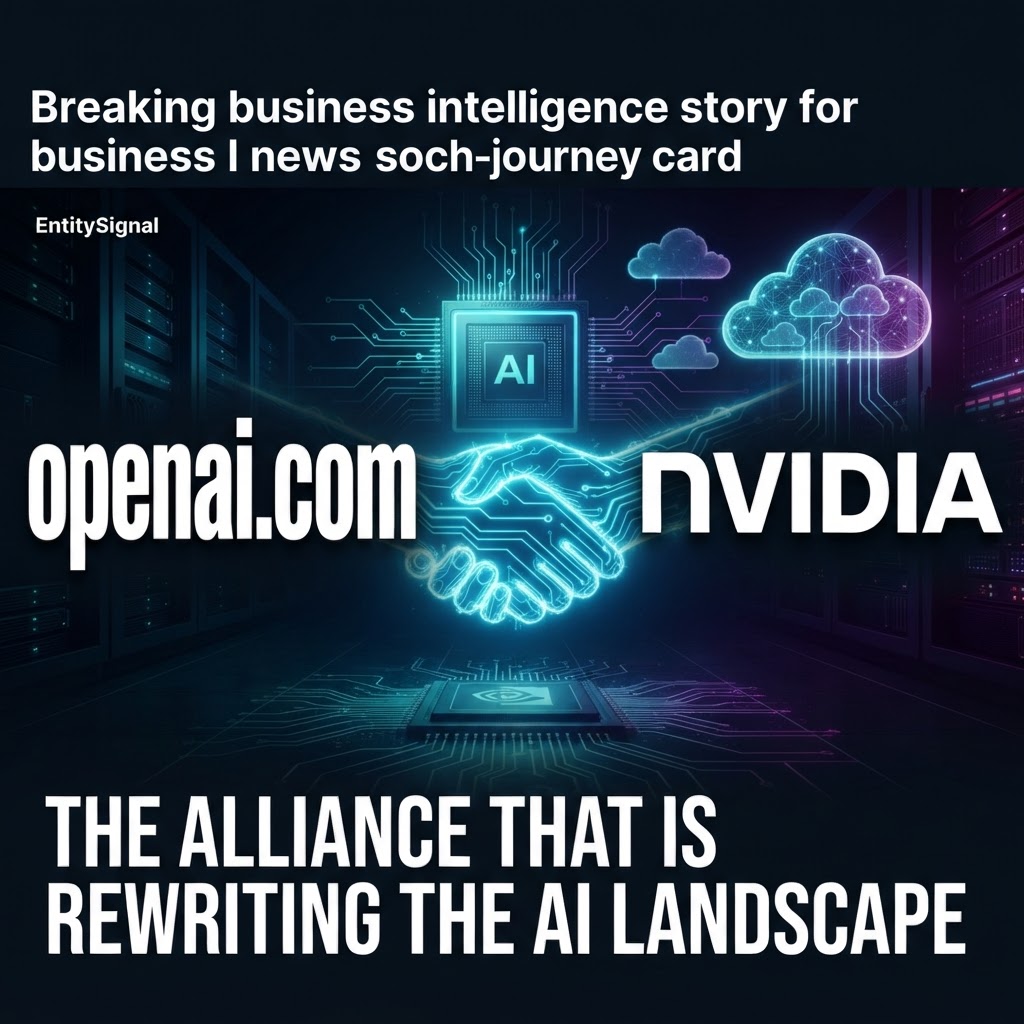
OpenAI: Strategic Consolidation and Ecosystem Expansion in the Generative AI Race
OpenAI is aggressively solidifying its infrastructure foundation through high-level partnerships with NVIDIA and Microsoft while simultaneously broadening its application layer integration. This multi-pronged approach positions the organization as both a dominant platform provider and an unavoidable competitor to incumbent cloud giants.
Strategic Overview
OpenAI’s current trajectory reflects a calculated strategy to secure physical compute dominance while accelerating developer adoption. By cementing partnerships with industry titans NVIDIA and Microsoft, OpenAI has effectively insulated its primary research initiatives from supply chain volatility and infrastructure scarcity. These relationships are not merely transactional; they represent a deep integration of capital, hardware, and deployment logistics that creates a formidable barrier to entry for smaller market participants.
Competitive Positioning
This consolidated infrastructure approach serves as the frontline in OpenAI’s ongoing rivalry with Google Cloud and Meta. As Google attempts to leverage its proprietary TPU architecture to counter OpenAI’s reliance on NVIDIA’s H100 ecosystem, OpenAI’s partnership with Microsoft Azure provides a diversified, scalable deployment pathway that is increasingly difficult for independent competitors to replicate. Simultaneously, the friction with Meta highlights a fundamental divide in industry philosophy: closed-model proprietary power versus open-source democratization. OpenAI’s decision to maintain a distinct competitive posture against Meta indicates an intention to keep its primary model architecture behind a restrictive API, effectively forcing enterprise adopters to choose between platform stability and open-source flexibility.
Ecosystem Integration
Beyond infrastructure, OpenAI’s deliberate integration with LangChain signifies a focus on the 'middle-ware' layer of AI development. By ensuring seamless connectivity with the industry-standard framework for Large Language Model (LLM) orchestration, OpenAI is effectively dictating the developer experience. This makes migrating to a competing provider technically burdensome for developers already embedded within the LangChain-OpenAI workflow, further increasing switching costs.
What This Means
For market observers and enterprise stakeholders, these relationships signal that the era of 'model-only' differentiation is ending, shifting toward 'platform-ecosystem' dominance.
- Infrastructure Moat: The partnership with NVIDIA and Microsoft creates a long-term supply advantage that smaller firms cannot match without significant capital expenditure.
- Standardization Trap: By facilitating deep integration with LangChain, OpenAI is standardizing its API as the baseline for agentic AI development, effectively forcing competing models to chase compatibility rather than disruption.
- The 'Big Tech' Convergence: We are seeing the crystallization of a two-polar world where OpenAI-Microsoft acts as the primary incumbent force against the decentralized, model-agnostic ambitions of competitors like Meta and Google Cloud.
Cross-Linked Intelligence
Related Discoveries — Semantic Match
This Article Connects To™
Connected Entities
Related Topics
This intelligence story connects 6 primary entities, 89 eligible public relationships, 10 related topics, and 60 neighboring companies across the EntitySignal graph.Counts reflect a bounded eligible public result set.
🌐 Continue Exploring the Intelligence Network™
You're not reading a blog — you're exploring a living knowledge graph. Every discovery connects to dozens more.
50
Related Discoveries (bounded)
6
Connected Companies (bounded)
14
Ecosystem Articles (bounded)
12
Competitive Insights (bounded)
Related Partnerships
Same Ecosystem
Vultr Deepens Integration within the Expanding Kubernetes Ecosystem
Vultr
42d ago
Mapping the Competitive Landscape: Backblaze and AWS
42d ago
Mapping the Foundational Link Between Linux Containers and Docker
47d ago
Mapping the Digital Footprint: Bundesbank and Wikipedia Proximity
47d ago
Similar Companies
Mailgun Integration with HubSpot Identified by EntitySignal Browser
Mailgun
42d ago
Mapping the Competitive Landscape: Backblaze and AWS
42d ago
Clearbit Integrates With HubSpot: Mapping the Latest B2B Tech Connectivity
42d ago
Cloudsmith Ecosystem Connectivity: Google Cloud, Microsoft Azure, and GitHub Integrations
48d ago
Trending Intelligence
Cloudsmith Ecosystem Connectivity: Google Cloud, Microsoft Azure, and GitHub Integrations
48d ago
Mapping Klaviyo’s Strategic Ecosystem: Partnerships and Competitive Positioning
Klaviyo
54d ago
Mapping the Connectivity Landscape Surrounding Mailgun
Mailgun
56d ago
Mapping Vultr's Competitive and Collaborative Ecosystem
Vultr
56d ago
🌐 Keep Exploring the EntitySignal Intelligence Network™